
Heartbreak and Hope in the Shadow of War
As the war escalates across the region, colleagues and friends are asking me how I am, how I feel, and I honestly don’t know how to answer. Some look me in the eye and then see the answer for themselves. Heartbroken.
Heartbroken and so very sorry that a new generation is living through what we did.
Our Lebanon team are being dragged into the sleepless nights and terror again that only war can bring. For so many, this is re-traumatising as they have already lived through so much. Others are young mothers who are answering the painful questions children should never have to ask: “Are people dying mummy?” , “Are we going to die?”

My nieces are not at school because of the war. They have now joined the 30 million children across this region who were out of school because of conflict even before this latest crisis started.
Our Persian team has been working through ongoing challenges for years, supporting Christians in fear of the consequences of living out their faith. But this year it took a darker, sinister turn and now their people are trapped between brutal oppression and bombardment. All our team can do from studios outside Iran is be there, in prayer, in the office, at home, producing programmes and – whenever people do reach out – let them know they are not alone.
As I write today, the world is debating over who holds responsibility for the 170 deaths of mostly Iranian girls who were killed at school when the bombings started. Just this week, 17 girls were killed when a drone attack in southern Sudan hit their school.
The world’s media is turning its back on Gaza which became a graveyard to 20,000 children over the space of two years. And the numbers of children killed or injured across the region since the outbreak of this latest conflict in just two weeks is over 1000.
We must not look away. We must not leave these children to languish.
These children are the future of this region, but what does that future look like when so many children are being denied a home? And a childhood? An education? And for thousands, even a family?
I became the CEO of this ministry seven years ago, determined that we would continue to grow if that is what God wanted us to do. We have grown – and in crisis, we are everywhere our viewers need us to be: online, on satellite television, on our video-on-demand platform, on messaging apps.
Decades before, I started content on our Arabic channel specifically for children – one-hour blocks at a time. These blocks grew into a 24/7 channel for Arab children: SAT-7 KIDS. This has become the place where so many Arabic speaking children are having a childhood, a community and an informal education. It is so important to continue to be this place of safety, of connectedness. Parents tell us that their children can only sleep if we are on. Others have said they feel protected by the wings of the angels when they watch us.
Please pray for us. Pray that our teams can continue to be there for every child who needs us. Please pray that the violence ends. Please pray that the hope we share is a comfort to every person that connects with us. And please pray that we can be strengthened and, in these most difficult of days, still hold onto hope.
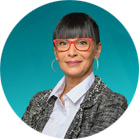
Rita El-Mounayer
SAT-7 Chief Executive Office
Rita was born in Lebanon, and has been working in Christian media since 1992. She began her studies with History and Social Science in the Lebanese University of Beirut, then, having a heart for children and people in need, she studied and taught communications for deaf and mute children at the Father Andrew Institute in Beirut. In 1992, Rita joined FEBA radio where she wrote programs for youth and helped with follow up, as well as taking courses in Islam, script writing and child abuse. She joined SAT-7 in 1996, where she worked as a producer and writer for As Sanabel, and host of the popular Bedtime Stories with Rita program. Rita earned her Masters Degree in Communication Practice from the University of Wales in 2004. She was later appointed as Executive Director of the Arabic Channels of SAT-7 in 2005. She is currently pursuing a Masters of Religion in Middle Eastern and North African Studies from the Institute of Middle East Studies, Lebanon. In 2016, she was appointed as the Chief Channels and Communications Officer, responsible for five channels in Arabic, Farsi, and Turkish. In April 2019, she was appointed as CEO. She is a member of the SAT-7 leadership team and currently lives in Cyprus.