
Back to school – but not for everyone
Conflict keeps millions out of school but SAT-7 offers alternative learning opportunities
This autumn, millions of children will return to classrooms across the Middle East and North Africa (MENA). Millions more will not. From war-damaged schools in Sudan, Gaza and Lebanon to classrooms forbidden to girls in Afghanistan, SAT-7 is helping children hold on to learning. And to hope.
New shoes. Sharpened pencils. A schoolbag packed the night before. For millions of children, the coming weeks will bring the familiar rituals of a new school year.
But for millions of others, there will be no classroom to return to.
Conflict, displacement, poverty and restrictions on education are keeping children away from school – sometimes for months or even years. Across the MENA, an estimated 30 million children aged five to 18 are out of school.
Eight million missing from classrooms
Nowhere is the scale more devastating than Sudan.
After more than three years of conflict, at least eight million school-aged children are out of school, according to UNICEF. Nearly half of the country’s school buildings are no longer functioning as classrooms; some have been damaged by fighting, while others shelter families displaced by violence.
In Darfur alone, more than three million of the region’s nearly four million school-aged children are out of school.
Access to education for Sudanese refugees in other countries can be problematic too, as highlighted in a SAT-7 campaign video called The Chair, which urges people to “make room” for the displaced and needy in their communities.
No classroom to return to
Recent conflict has forced children in other MENA countries out of school, too.
In Lebanon, a nationwide assessment found 340 schools damaged or destroyed by the recent fighting. UNICEF warned in July that at least 100,000 children could be left without a classroom when the new academic year begins unless urgent repairs are made.
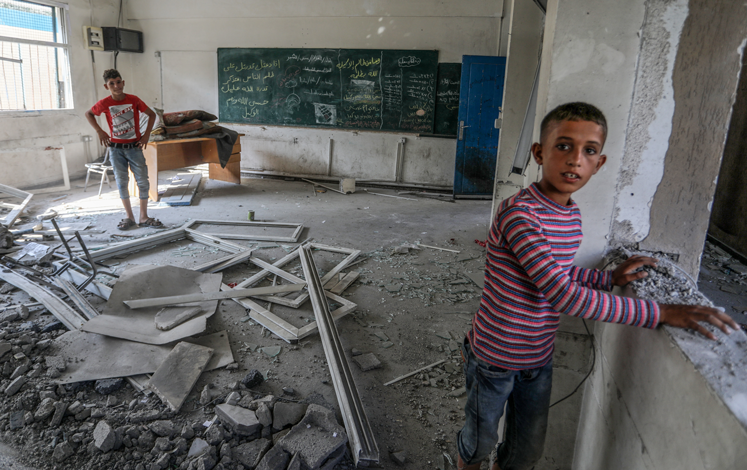
The situation is even more acute in Gaza, where almost an entire generation has been deprived of normal schooling.
Around 700,000 children have missed formal, in-person education for almost three consecutive school years. Nearly 98 per cent of school buildings have been damaged, with more than 93 per cent requiring major rehabilitation or complete reconstruction. Around 420,000 children currently have no access to face-to-face learning at all.
For Arabic-speaking children whose education has been disrupted by conflict, SAT-7 continues to make its My School educational programme freely available. Originally launched in response to the Syrian civil war, its 400-plus episodes cover core primary subjects including Arabic, English, maths and science, and remain available through the SAT-7 KIDS channel and the SAT-7 PLUS streaming platform.
“I lost hope”
In Afghanistan, the classroom presents a different kind of barrier. After five years of Taliban rule, it remains the only country in the world where girls and women are forbidden from secondary and higher education. Over two million are now barred from attending school beyond primary level.
Armineh was 16 when she told SAT-7 what the Taliban’s return in 2021 meant for her education.
“Before the Taliban came, I was studying English and I was planning after completing my course to prepare for my university entrance exams,” she said. “But with the current situation, I am unable to attend my courses or to continue my education as before… I lost hope; it was as if all the doors were closed to me.”
For girls, women and others who cannot access education in Afghanistan, SAT-7 is bringing learning to them through SAT-7 PARS programme Sun of Hope. The show offers literacy and numeracy lessons in Dari, Afghanistan’s most widely spoken language, and viewers are following the episodes in their homes and makeshift classrooms.
“In our village, we decided to start a Dari language learning class,” one Afghan viewer told SAT-7. “During the broadcast, I gather eight children and two adults in a room, and we follow your lessons together.”
For those who do return
For children fortunate enough to walk through the school gates this autumn, returning can bring its own worries.
Amid dire economic conditions in Iran, SAT-7 viewer Safie was unable to afford the basics her children needed.
“A week before school started, I was very distraught and worried: the children were crying, saying we still hadn’t got them bags, shoes or stationery.”
Safie prayed. Then, while she was in a shop trying to work out how the family could afford everything, a Christian friend called and came to meet her.
“She gave me her card. And she said, ‘This is a gift from God; go and pay for it.’ I was so happy; joy filled my being! Thanks be to the living God.”
Different circumstances
This autumn, the experience of “back to school” will look profoundly different from one child to another.
Some will carry new books. Some will wait for a damaged school to reopen. Some will remain forbidden from entering a classroom at all. Some will study through a television screen.
But wherever children are learning – or longing for the chance to learn – SAT-7 will continue to offer education, encouragement, faith and hope.